
Endothermic paint booth for body shops and industry
The MAT INDUS endothermic paint booth uses electric radiant panels to heat workpieces during drying. Discover how it works, how it compares with a gas-fired booth and which details to provide for a quotation tailored to your body shop or industrial workshop.
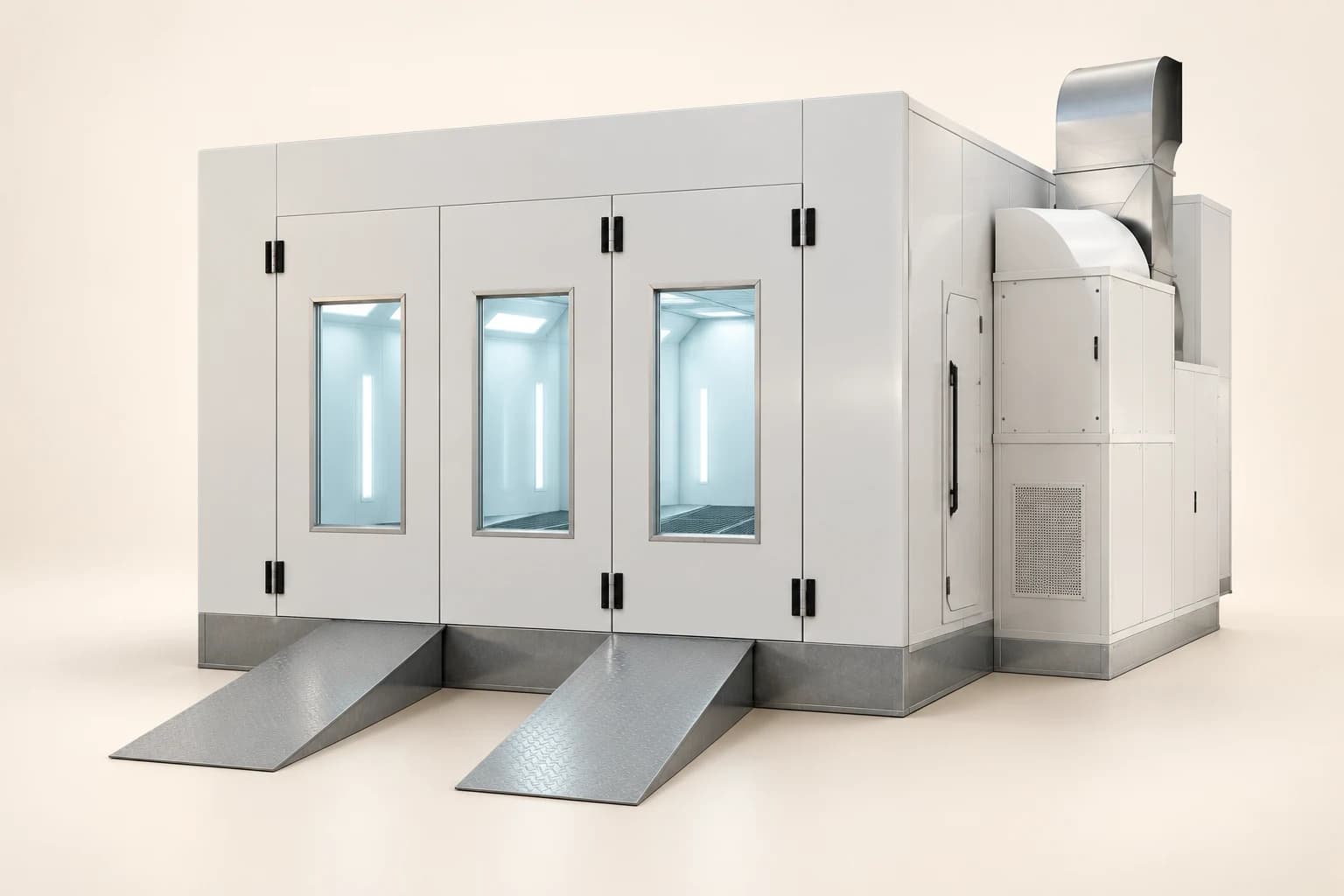
What is an endothermic paint booth?
An endothermic paint booth uses electric radiant panels. Instead of heating a large volume of air with a gas burner, the panels radiate heat toward the vehicle body, industrial part or painted substrate. Heat-up is fast, even and more energy efficient.
Why it supports workshop decarbonization
For body shops and industrial sites, the paint booth is often a major energy load. Switching to endothermic technology reduces gas dependency while preserving high productivity.
Zero direct emissions
No burner, no flame and no combustion inside the booth during the heating cycle.
Lower energy use
Heat is directed at the part, limiting losses from air renewal and unnecessary volume heating.
Faster cycles
A 5 to 10 minute heat-up helps workshops run more cycles during the day.
Simpler maintenance
No burner or heat exchanger means fewer thermal components to inspect and maintain.
Gas booth vs endothermic booth
The comparison should be based on your real usage: cycles, booth size, gas price, electricity price and production rhythm.
| Criteria | Gas booth | Endothermic booth |
|---|---|---|
| Energy | Gas combustion | Electric radiant heating |
| Direct emissions | CO₂ from the burner | No direct booth emissions |
| Heat-up time | Depends on air volume | 5 to 10 minutes depending on setup |
| Maintenance | Burner, exchanger, combustion | Fewer thermal parts to inspect |
How much does an endothermic paint booth cost?
The price depends on the configuration and installation work required. When comparing quotations, check what is included: booth, radiant panels, ventilation, filtration, electrical supply, transport, assembly and commissioning. A technical assessment separates equipment costs from the cost of integrating it into your workshop.
Consumption, heating time and payback vary with workpieces, cycles, ventilation and energy prices. The calculator provides an estimate using the displayed assumptions, not a guaranteed result. Have your configuration and expected performance checked during the technical assessment.
What to prepare for your quotation
- Workpiece dimensions, available floor space, clearance and building access.
- Paint types, drying temperatures and number of cycles per day.
- Available electrical capacity, ventilation, filtration and condition of any existing booth.
- Production targets, energy rates, budget and preferred schedule.
Priority applications
- Automotive body shops aiming to reduce gas use and stabilize energy costs.
- Industrial workshops painting metal, wood, plastic or custom large parts.
- High-cycle sites looking for measurable ROI and a lower carbon footprint.
- Networks aligning paint booths with a broader decarbonization strategy.
MAT INDUS method
Cycle audit
We review booth area, frequency, temperature, energy use and regulatory constraints.
Economic simulation
We compare gas and endothermic scenarios using your production assumptions.
Custom design
The booth, panels and ventilation are sized for your workshop.
Installation and follow-up
Assembly, commissioning, inspection and maintenance are handled by one team.
Frequently asked questions
Is an endothermic booth suitable for body shops?
Yes. It is especially relevant for body shops that want to reduce gas consumption, speed up heat-up time and improve their carbon trajectory.
Is it a sustainable paint booth?
It does not make the whole process carbon neutral, but it removes gas combustion during heating and significantly reduces direct booth emissions.
Can an existing booth be converted?
Depending on the condition, structure and ventilation of the booth, MAT INDUS can assess a conversion or propose a new sized booth.
How is ROI calculated?
ROI depends on cycles, energy prices, booth size and investment premium. The MAT INDUS simulator provides an initial estimate.
How much does an endothermic paint booth cost?
There is no single price: dimensions, panels, ventilation, electrical capacity and installation work determine the quotation. Specify production volumes and building constraints to compare quotations covering the same scope.
What is the difference between an electric and an endothermic paint booth?
An electric booth may heat the air or use radiant panels. Endothermic here refers to radiant heating directed at the workpieces. Check the heating method and ventilation requirements: not all electric booths work in the same way.
Prepare your project
Want to reduce gas use in your workshop?
We prepare a free study with energy estimate, carbon gains and return-on-investment scenario.